
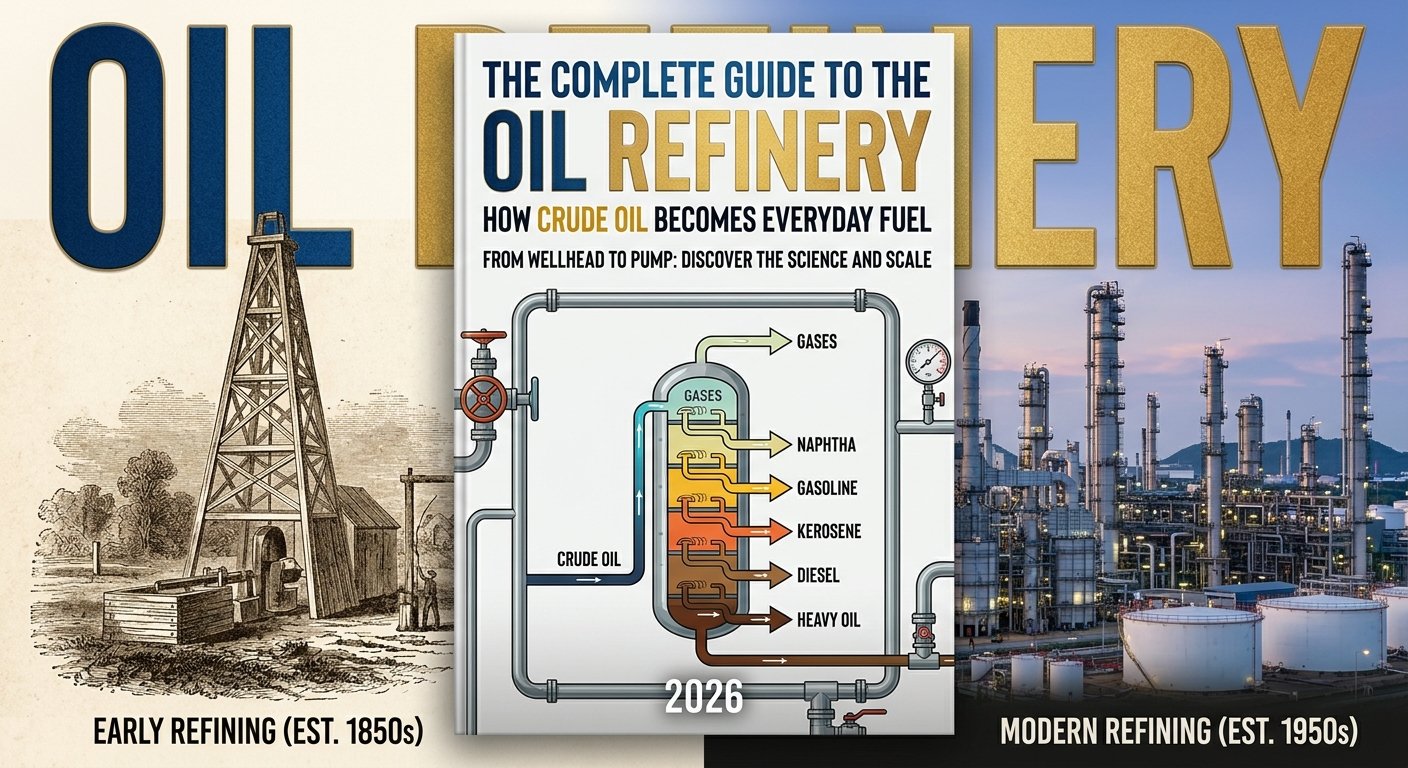
The oil refinery is one of the most consequential industrial facilities on the planet, yet most people never see one up close. It sits behind fences and security gates, a sprawling complex of towers, pipes, and furnaces that hums day and night. What happens inside those boundaries shapes everything from the price you pay at the pump to the availability of the plastics in your phone and the fertiliser that grows your food. Understanding this facility is not just a matter of industrial curiosity. It is a lesson in how the modern world actually functions.
The numbers are staggering. There are roughly 658 refineries operating worldwide, together processing tens of millions of barrels of crude oil every single day . These facilities take a raw material of limited direct use and transform it into the fuels, lubricants, and chemical feedstocks that keep economies running. A barrel of crude oil, in its unrefined state, has little practical application. Once it passes through the right combination of heat, pressure, and catalysis, it becomes gasoline, diesel, jet fuel, and a hundred other products that society depends on.
This guide digs into the machinery, chemistry, economics, and geopolitics of the oil refinery. It covers how the basic processes work, why refineries differ so dramatically from one another, what the industry looks like today, and where it is heading. Whether you are a student of energy systems, an investor trying to understand the sector, or simply someone who wants to know what goes on inside those distant industrial complexes, this is the deep dive you need.
What an Oil Refinery Actually Does
At its core, an oil refinery is a factory that separates and transforms crude oil into finished products with specific properties. Crude oil is a mixture of thousands of different hydrocarbon molecules, ranging from light gases to heavy, tar-like compounds. In its raw form, this mixture is too variable and impure to be useful. The refining process sorts these molecules by size and boiling point, then applies chemical reactions to convert low-value components into high-value ones .
The purpose is not just separation but value creation. Light and sweet crude oils, which contain a higher proportion of smaller hydrocarbon molecules and fewer impurities, are more expensive but yield more gasoline and diesel. Heavier, sourer crudes are cheaper but require more complex processing to produce the same valuable products . This economic reality drives the entire design of a refinery. A facility built to process heavy Canadian oil sands crude looks radically different from one designed for light Middle Eastern crude.
Think of it like a water treatment plant crossed with a chemical laboratory. The crude oil enters, gets heated until it vaporises, and then gets sorted into different streams based on how easily each component boils. Some of those streams are ready to sell almost immediately. Others need to go through additional units that crack large molecules into smaller ones, reshape molecules into more valuable configurations, or remove impurities like sulfur. The output is a slate of products calibrated to what the market actually wants.
The Three Pillars: Separation, Conversion, and Treatment
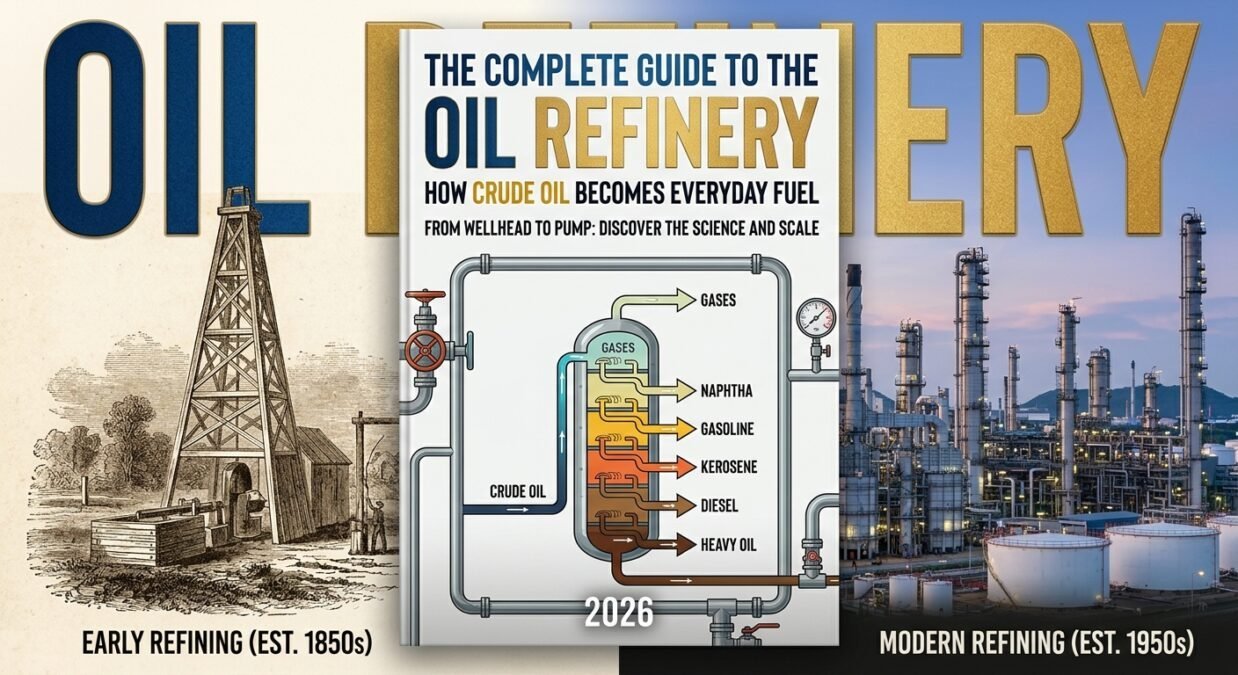
Every refinery, regardless of its size or complexity, relies on three fundamental categories of processes. The first is separation, which is almost always distillation. Crude oil is heated in a furnace until most of it turns to vapour, then piped into a distillation tower. Inside the tower, the vapour rises and cools as it goes. Different hydrocarbon fractions condense at different heights depending on their boiling points. The lightest fractions, like gasoline and liquefied petroleum gas, rise to the top. Medium-weight fractions like kerosene and diesel stay in the middle. Heavy gas oils and residual material settle at the bottom .
The second pillar is conversion, which takes low-value fractions and turns them into high-value ones. The most widely used conversion method is cracking, which uses heat, pressure, and often catalysts to break heavy hydrocarbon molecules into lighter ones. A fluid catalytic cracking unit, for example, takes heavy gas oil and produces additional gasoline components. Hydrocracking combines cracking with hydrogen to produce diesel and jet fuel from heavier feeds . Other conversion processes include reforming, which rearranges naphtha molecules into higher-octane gasoline components, and alkylation, which combines small gaseous molecules into larger ones .
The third pillar is treatment, which removes impurities that would otherwise cause problems. Sulfur is the most important target. Hydrotreating reacts the feed with hydrogen in the presence of a catalyst to convert sulfur compounds into hydrogen sulfide, which is then captured and processed into elemental sulfur . Other treatments remove nitrogen, oxygen, and trace metals. Without these steps, fuels would produce harmful emissions and poison the catalysts used in downstream processes.
| Process Category | Primary Function | Key Units | Typical Products |
|---|---|---|---|
| Separation | Sort molecules by boiling point | Atmospheric and vacuum distillation | Naphtha, kerosene, diesel, gas oils |
| Conversion | Transform heavy molecules into lighter ones | Fluid catalytic cracking, hydrocracking, reforming, coking | Gasoline blendstocks, diesel, jet fuel |
| Treatment | Remove impurities like sulfur and nitrogen | Hydrotreating, sweetening, amine treating | Clean fuels meeting regulatory specs |
The Journey of a Barrel: From Crude to Gasoline
Tracing a single barrel through a refinery illustrates how the pieces fit together. The crude oil arrives by pipeline, tanker, or rail and is stored in large tanks. It is then desalted to remove water and inorganic salts that would corrode equipment. The desalted crude enters a furnace and is heated to around 350 to 400 degrees Celsius. That hot mixture goes into the atmospheric distillation tower, where it separates into fractions .
The naphtha fraction, which boils at relatively low temperatures, goes to a reforming unit. There, heat and a catalyst rearrange its molecules to increase octane, producing a gasoline blendstock. The kerosene fraction may be treated and sold as jet fuel or further processed. The diesel fraction is hydrotreated to reduce sulfur and improve its combustion characteristics. The heavy gas oil goes to the fluid catalytic cracking unit, where it is broken into lighter molecules that become additional gasoline and diesel components.
The heaviest material from the bottom of the atmospheric tower goes to a vacuum distillation unit, which separates it further under reduced pressure. The residue from that process may go to a coker, which applies extreme heat to break it down into lighter products and petroleum coke, a solid carbon material used in power generation and aluminium manufacturing . Every stream is routed and recombined to create the final product slate, which is then blended to meet precise specifications for octane, cetane, vapor pressure, and sulfur content.
Why Refineries Are Not All the Same
A simple refinery, sometimes called a hydroskimming refinery, has only distillation, reforming, and hydrotreating. It can produce gasoline and diesel from light, sweet crude but cannot handle heavy feeds or maximise the yield of high-value products. A complex refinery, by contrast, includes cracking, coking, alkylation, and other conversion units. It can process cheaper heavy crude and squeeze more gasoline and diesel out of every barrel .
The choice of configuration is driven by economics. Building a complex refinery costs billions of dollars, but it allows the operator to buy cheaper feedstock and sell more valuable products. In regions where light sweet crude is abundant and cheap, a simpler configuration may make sense. In regions where heavy crude is the available feedstock, as in Canada, coking capacity is essential. The Canadian refining sector, for example, has limited coking capacity, which means much of the country’s heavy oil must be exported to refineries elsewhere that can process it .
Location matters too. A refinery near a major port can import crude from multiple sources and export finished products easily. An inland refinery may be tied to a specific pipeline network and a regional market. Regulatory environment, labour costs, and access to hydrogen and other utilities all influence design. There is no universal refinery blueprint. Each one is a bespoke solution to a specific set of constraints and opportunities.
The Economics of Refining: Margins, Cracks, and Cycles
Refining is a high-volume, low-margin business that swings dramatically with market conditions . The key metric is the crack spread, which measures the difference between the price of crude oil and the price of the refined products made from it. A 2-1-1 crack spread, for example, represents the profit from processing two barrels of crude into one barrel of gasoline and one barrel of diesel. When product prices rise relative to crude, margins expand. When crude prices spike or product demand collapses, margins compress or turn negative .
The past two decades have been brutal for Western refining. Major oil companies steadily retreated from the sector, deterred by high operating costs, volatile margins, rising carbon costs, and competition from state-backed refiners in the Middle East and Asia . Combined refining volumes for BP, Chevron, ExxonMobil, Shell, and TotalEnergies fell from 16.4 million barrels per day in 2005 to 10.4 million barrels per day by 2025, a drop from roughly 22 percent of global capacity to about 13 percent . Shell led the retreat, reducing its refinery interests from 40 to just seven over that period .
That retreat reversed temporarily in 2026. Geopolitical disruptions, including the effective closure of the Strait of Hormuz and attacks on Middle Eastern and Russian refineries, removed roughly 5 million barrels per day of global refining output in the second quarter . Refining margins soared. BP’s refining indicator margin climbed to $30 per barrel in the second quarter from $12 a year earlier, then averaged $42 per barrel in the third quarter . Exxon posted downstream profits of $5.5 billion, its strongest result since 2022. Chevron’s downstream earnings hit $4.9 billion . The golden era, however, is unlikely to last. Long-term structural changes in oil consumption mean refining’s star will fade as electrification and efficiency reduce demand for transportation fuels.
The Human and Economic Footprint
Refineries are economic anchors for their regions. In the United Kingdom alone, domestic refining directly supports around 4,000 highly skilled jobs and a further 100,000 in the wider supply chain, concentrated in industrial heartlands like the Mersey, Humber, Southampton, and South Wales . The sector generates approximately £11 billion per year in export income and provides direct gross value added of £3 billion, with a total use of £45.5 billion when accounting for refined products as inputs to other sectors .
A 2025 study using an inter-regional input-output model found that the economic impact of the refining industry is 2.45 times higher than its direct gross product, suggesting a significant multiplier effect through the petroleum value chain . The industry contributes in relative terms to a greater extent in countries with a small or modest presence in world petroleum product markets, such as the Netherlands, Norway, and Canada . Refining is not just about fuel. It is about industrial capability, supply chain resilience, and the foundation for sectors ranging from chemicals to pharmaceuticals.
Environmental and Safety Challenges
The environmental footprint of an oil refinery is substantial and heavily regulated. Combustion sources like process heaters and boilers emit nitrogen oxides, sulfur dioxide, carbon monoxide, and particulate matter. Venting and flaring are used for safety during non-routine operations, but flaring converts hydrogen sulfide into sulfur dioxide and hydrocarbons into carbon dioxide and water vapour . The World Bank’s environmental guidelines for petroleum refining recommend flare gas recovery systems, efficient flare tips, and continuous monitoring to minimise emissions .
Water management is another critical area. Refinery wastewaters often require a combination of treatment methods, including sour water stripping, gravity oil-water separation, dissolved air flotation, biological treatment, and clarification . Good design and operation can achieve a wastewater generation rate of 0.4 cubic metres per tonne of crude processed, with pollutant loads including BOD5 of 6 grams, COD of 50 grams, suspended solids of 10 grams, and oil and grease of 2 grams per tonne of crude . Solid wastes and sludges should be less than 0.5 percent of crude processed, with a target of 0.3 percent .
Safety is a constant concern in an industry that handles flammable and toxic materials at high temperatures and pressures. The potential for fire exists wherever hydrogen or light hydrocarbons are present. Spent caustic solutions, used to remove hydrogen sulfide and mercaptans, create hazards if not handled properly . Corrosion monitoring, leak detection and repair programs, and rigorous emergency preparedness are standard practices. The sector’s safety record has improved over decades, but the inherent risks mean that vigilance is never optional.
The Major Players and the Global Map
The world’s largest refineries are concentrated in Asia and the Middle East. The Jamnagar Refinery Complex in Gujarat, India, owned by Reliance Industries, is the largest single-site refinery in the world, with a processing capacity of approximately 1.24 million barrels per day . It spans 7,500 acres and supplies about one-third of India’s oil needs . The Paraguaná Refining Complex in Venezuela, operated by PDVSA, handles about 940,000 to 955,000 barrels per day and hosts the world’s largest flexicoker unit .
South Korea punches far above its weight in refining. The Ulsan Refinery, run by SK Energy, processes about 840,000 to 850,000 barrels per day. The Yeosu Refinery, operated by GS Caltex, handles roughly 775,000 to 840,000 barrels per day. The Onsan Refinery, operated by S-Oil, produces about 669,000 barrels per day . These facilities are among the most technologically advanced in the world, with units designed for high conversion and clean fuels production.
The Dangote Refinery in Lagos, Nigeria, represents a new chapter. With a current capacity of 650,000 barrels per day, it is Africa’s largest refinery and has already transformed Nigeria from a fuel importer to a net exporter of diesel and jet fuel . Owner Aliko Dangote has announced plans to double capacity to 1.4 million barrels per day, which would make it the largest refinery in the world, surpassing Jamnagar . The expansion reflects a broader shift in global refining capacity toward regions with growing demand and access to capital.
| Refinery | Location | Capacity (bpd) | Owner |
|---|---|---|---|
| Jamnagar | Gujarat, India | 1.24 million | Reliance Industries |
| Paraguaná | Falcón, Venezuela | ~940,000 | PDVSA |
| Ulsan | Ulsan, South Korea | ~850,000 | SK Energy |
| Yeosu | Yeosu, South Korea | ~775,000 | GS Caltex |
| Onsan | Ulsan, South Korea | ~669,000 | S-Oil |
| Dangote | Lagos, Nigeria | 650,000 | Dangote Industries |
The Future of Refining: Transition and Adaptation
The long-term outlook for refining is shaped by the energy transition. Transportation fuels, which account for the majority of refinery output, face declining demand as electric vehicles penetrate the passenger car market and efficiency standards tighten. The UK’s refining sector has already seen two closures in a single year, and the country now imports more than half its diesel . Western oil majors have been shrinking their refining footprints for two decades .
But refining is not disappearing. It is adapting. Non-fuel products are becoming increasingly important. Around 50 percent of the European chemical sector’s feedstocks come from refineries, supporting pharmaceuticals, plastics, fertilisers, paints, adhesives, lubricants, and bitumen . Refineries supply inputs for batteries, data-centre cooling fluids, carbon fibre for wind turbines, and many of the materials used in electric vehicles. The International Energy Agency’s analysis finds that non-fuel products used as feedstock in chemicals already account for around 12 to 14 percent of global oil demand, and this share is expected to increase .
Refineries are also becoming hubs for low-carbon fuels and technologies. Sustainable aviation fuel, renewable hydrogen, biofuels, and carbon capture are being integrated into existing refining infrastructure . The skills, equipment, and supply chains that refineries have built over decades are directly transferable to these new industries. The refinery of the future may look different, but the industrial capability it represents will remain essential.
Frequently Asked Questions
What is the main purpose of an oil refinery?
The main purpose of an oil refinery is to transform crude oil, which has limited direct use, into finished products that meet precise market specifications. These products include liquefied petroleum gas, gasoline, kerosene, jet fuel, diesel, heating oil, lubricants, and feedstocks for the petrochemical industry . The refining process separates crude oil into fractions by boiling point, converts low-value fractions into higher-value ones through chemical reactions, and treats the resulting streams to remove impurities like sulfur. Without refining, crude oil would be of little practical value to modern society.
How does distillation work in the refining process?
Distillation separates crude oil into different fractions based on differences in boiling points. The crude is heated in a furnace until most of it vaporises, then enters a distillation tower. As the vapour rises, it cools, and different hydrocarbon components condense at different heights. Light fractions like gasoline and liquefied petroleum gas rise to the top, medium-weight fractions like kerosene and diesel stay in the middle, and heavy gas oils and residue settle at the bottom . Atmospheric distillation is the first and most basic step in almost every refinery, and it is often followed by vacuum distillation to further separate heavy residual material .
What is the difference between cracking and reforming?
Cracking breaks large, heavy hydrocarbon molecules into smaller, lighter ones that are more valuable. It uses heat, pressure, catalysts, and sometimes hydrogen. Fluid catalytic cracking and hydrocracking are the most common commercial cracking processes . Reforming, by contrast, rearranges the molecular structure of hydrocarbons without significantly changing their size. It is primarily used to convert low-octane naphtha into high-octane gasoline components . In simple terms, cracking makes big molecules smaller, while reforming changes the shape of molecules to improve their properties.
Why do refineries need hydrotreating units?
Hydrotreating units remove impurities, particularly sulfur, from petroleum fractions by reacting them with hydrogen in the presence of a catalyst. Sulfur must be removed because it would otherwise produce harmful emissions when the fuel is burned and would poison the catalysts used in downstream refining processes . Hydrotreating is effective against all sulfur species, including the more complex compounds found in heavier fractions, which is why it is the most widely used desulfurisation method in modern refineries . It also removes nitrogen and oxygen compounds and saturates olefins, improving fuel stability.
What are the largest oil refineries in the world?
The largest single-site oil refinery in the world is the Jamnagar Refinery Complex in Gujarat, India, with a capacity of approximately 1.24 million barrels per day . The Paraguaná Refining Complex in Venezuela, with about 940,000 barrels per day, is the largest in the Western Hemisphere . South Korea hosts three of the world’s largest refineries: Ulsan, Yeosu, and Onsan, with capacities ranging from roughly 669,000 to 850,000 barrels per day . The Dangote Refinery in Nigeria, at 650,000 barrels per day, is Africa’s largest and has announced plans to expand to 1.4 million barrels per day .
Conclusion
The oil refinery is a testament to industrial engineering at its most ambitious. It takes a raw material that would otherwise be of little use and, through a carefully orchestrated sequence of heating, separating, cracking, and treating, transforms it into the fuels and feedstocks that underpin modern life. The facility is not glamorous. It is a tangle of pipes and towers, a place of heat and pressure and constant vigilance. But its output powers vehicles, heats homes, grows food, and manufactures the countless products that define contemporary existence.
The industry faces genuine challenges. Margins are volatile, Western capacity has shrunk, and the long-term transition away from fossil fuels for transportation is underway. Yet the oil refinery is not a relic. It is adapting, shifting toward chemical feedstocks, sustainable fuels, and new materials that the energy transition itself requires. The skills and infrastructure embedded in these complexes will remain valuable for decades, even as the product slate evolves.
The final insight is this: understanding the oil refinery is understanding the material foundation of the modern world. Every plastic bottle, every pharmaceutical, every mile driven on asphalt sits at the end of a chain that begins with crude oil and passes through a refinery. The facility may sit behind a fence, unseen and unconsidered by most people. But its importance is impossible to overstate. The refinery is where the raw material of the earth becomes the tools of civilisation.